Vermont Dog Registration Information
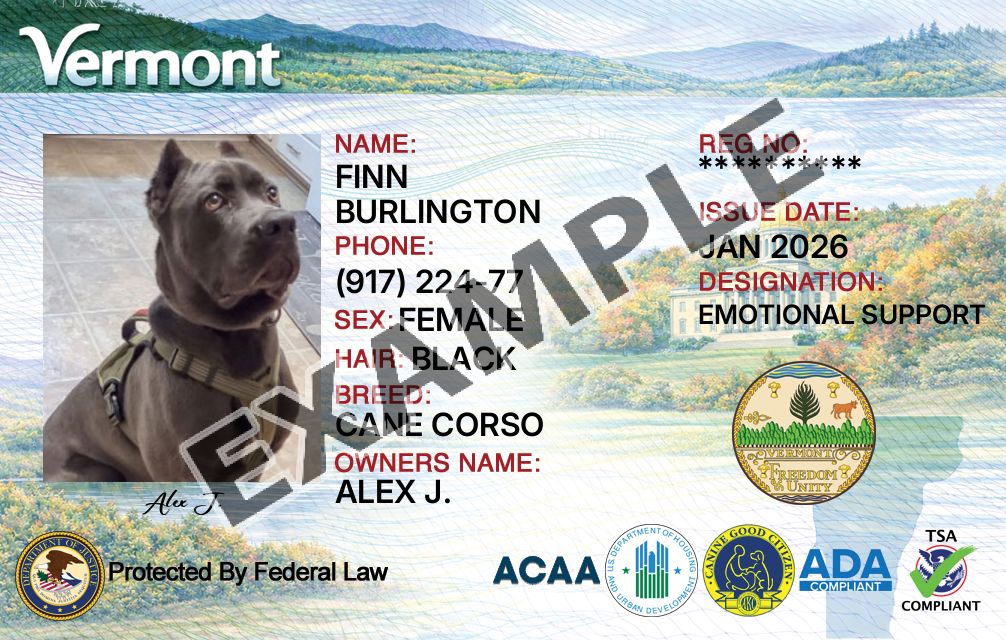
State Licensed, Service Dogs and Emotional Support Dogs in Vermont
Registering a Dog in Vermont: What “Registration” Really Means
If you’re searching where do I register my dog in Vermont for my service dog or emotional support dog, the most important thing to know is this: in Vermont, “registering” a dog usually means getting a dog license in Vermont through your local city or town clerk—not through a statewide service-dog registry and not through any third-party website.
This page explains where to register a dog in Vermont, what offices handle licensing and rabies documentation, and how dog licensing differs from a dog’s service dog legal status or emotional support animal (ESA) housing rules.
Where to Register or License Your Dog in Vermont
Because animal control dog license Vermont requirements are administered locally, you typically license your dog through the municipal clerk (often a City Clerk or Town Clerk) in the municipality where the dog is kept. Below are several examples of official Vermont offices that publicly list dog licensing as a clerk service or provide licensing instructions. Contact your local clerk if your town isn’t listed.
Burlington Clerk / Treasurer’s Office
South Burlington City Clerk’s Office
Montpelier City Clerk
City of Rutland — Office of City Clerk
Town of Brattleboro — Town Clerk
Overview of Dog Licensing in Vermont
What a “Dog License in Vermont” Is
A Vermont dog license is a local registration issued by your city or town (typically through the municipal clerk). It usually results in a license record and a tag. Licensing is commonly used for identification and for verifying that dogs are vaccinated against rabies. In many communities, licensing also supports local animal control operations and state animal welfare programs funded by fees.
Which Agencies Are Responsible (State vs. Local)
In practice, the agencies you’ll most often interact with include:
- City or Town Clerk (Municipal Clerk): Primary office where most residents obtain or renew a local dog license.
- Local Animal Control Officer / Animal Control Department (if your municipality has one): Enforces local ordinances (leash/running-at-large rules, nuisance complaints, impoundment, etc.).
- Town Health Officer: Often involved in bite reporting and rabies-related public health procedures.
- Vermont Department of Health: State public health authority for rabies information, bite reporting frameworks, and rabies hotlines/resources.
This is why searches like where to register a dog in Vermont often lead you to a clerk’s office page: the licensing transaction itself is local, even though the overall rabies/public-health system includes state-level guidance.
How Dog Licensing Works Locally in Vermont
Step-by-Step: Typical Local Licensing Process
- Confirm your municipality: License in the municipality where your dog is kept (City/Town Clerk).
- Gather required documents: Most clerks require a current rabies vaccination certificate for licensing (especially for a new dog in town or when rabies documentation is not already on file).
- Submit the application and fee: Many municipalities accept in-person payment; some also accept mail, drop-box, or online renewal depending on local systems.
- Receive your tag: Your dog should wear the tag as required by local practice and state/local rules.
- Renew annually: Vermont law sets a common annual schedule and many towns emphasize the April 1 deadline.
Local Deadlines and Where Confusion Happens
Vermont’s statewide framework requires annual licensing, and many towns highlight an April 1 deadline. Some communities open renewals in January and may charge a penalty after April 1. If you moved mid-year, you may wonder whether your previous town license transfers—it typically does not. Instead, your new municipality will tell you whether you should license immediately upon establishing residency or when your renewal is due.
Rabies Vaccination: What Vermont Requires and Why It Matters for Licensing
Vermont’s rabies prevention guidance emphasizes keeping pets vaccinated and up to date. In addition to being a critical health safeguard, rabies vaccination documentation is commonly tied to licensing: Vermont’s licensing statute requires owners to provide a rabies vaccination certificate (or certified copy) to the municipal clerk before obtaining a license for a dog six months of age or older.
If there’s ever a bite or potential exposure, Vermont public health guidance also points people to contact appropriate officials (including local town health officers) and provides rabies hotline resources for help with rabies questions and wildlife exposures.
Service Dog Laws in Vermont
There Is No Required “Service Dog Registration” Under the ADA
For public access (restaurants, stores, municipal buildings, etc.), the key standard comes from the Americans with Disabilities Act (ADA). Under ADA guidance, a service animal is a dog trained to perform a task directly related to a person’s disability. The ADA also explains that service animals are not required to be certified or use a professional training program, and staff generally may not require documentation that the dog is “registered, licensed, or certified” as a service animal.
What Businesses or Government Offices Are Allowed to Ask
When it’s not obvious that a dog is a service animal, ADA guidance allows staff to ask only two questions: (1) whether the dog is required because of a disability, and (2) what work or task the dog has been trained to perform. They cannot ask you to disclose the nature of your disability or demand “proof” of a service dog registry.
How Service Dogs Still Fit Into Local Licensing
Even though you do not “register” a service dog with a federal registry, a service dog can still be subject to the same local public health and licensing rules that apply to other dogs. ADA guidance notes that state/local governments can require service dogs to be licensed and vaccinated if those requirements apply to dogs generally. In other words: your service dog can be a legitimate service animal under the ADA, and you still typically obtain a local dog license in Vermont through your municipal clerk like any other dog.
Emotional Support Animal Rules in Vermont
An ESA Is Not the Same as a Service Dog
An emotional support animal (ESA) may provide emotional support that helps with one or more effects of a disability, but an ESA is generally not a service animal under the ADA for public access. ADA guidance explicitly distinguishes emotional support or comfort animals from service animals because comfort alone is not a trained task related to a disability.
Where ESAs Are Commonly Protected: Housing (Not Public Access)
ESAs most often come up in housing. HUD explains that an assistance animal is an animal that works, provides assistance, performs tasks, or provides emotional support that alleviates one or more identified effects of a person’s disability, and that an assistance animal is not a pet for fair housing purposes.
Practically, this means an ESA request is often handled as a reasonable accommodation with a housing provider—not as a dog “license” with a city or town clerk. However, even if your dog is an ESA for housing, you still typically need to follow your municipality’s rules for a local dog license and rabies vaccination.
Frequently Asked Questions
For most residents, the main “registration” is a local dog license in Vermont issued by your city/town clerk where the dog is kept. Public-access service dogs are not required to be registered in a government registry under the ADA. ESAs are typically addressed through housing reasonable-accommodation processes, not a statewide ESA registry.
If you’re unsure, call your municipal clerk and ask: “How do I license my dog, and what rabies certificate documentation do you need on file?”
Start with the City Clerk or Town Clerk for the municipality where you now live. Because licensing is local, your previous town’s license may not automatically carry over. Ask the clerk whether they want you to license immediately or align with the next renewal cycle, and whether they can transfer rabies documentation or need a fresh certificate.
Most municipalities require a current rabies vaccination certificate on file to issue a license, especially for a new dog or first-time licensing in that town. Many towns also set different fees for spayed/neutered dogs versus intact dogs.
If you’re renewing and the clerk already has valid rabies documentation, some municipalities may not require you to resubmit it—confirm with your local office.
No. A dog license is a local registration tied to identification and rabies compliance. A service dog’s legal status comes from disability law standards (ADA for public access), based on whether the dog is trained to perform tasks related to the handler’s disability—not from a license tag, vest, or registry card.
That’s common in Vermont because there are many municipalities. The correct answer to where to register a dog in Vermont is: contact the City/Town Clerk where your dog is kept and ask about dog licensing. If you’re not sure which municipality you’re in (especially in rural areas), confirm your local government office name using your property address or mailing address jurisdiction.
What You May Need
- rabies vaccination proof
- identification
- proof of residency
- licensing fee
Quick Clarity: License vs. Service Dog vs. ESA
Dog license (local)
A municipal record and tag. Usually tied to rabies compliance and identification. This is the most direct answer to “where to register a dog in Vermont.”
Service dog (public access)
A dog trained to perform tasks related to a disability. Not dependent on an online registry, ID card, or vest.
Emotional support animal (housing)
An assistance animal concept typically handled as a reasonable accommodation in housing—not a public-access right in most places. Still generally subject to local licensing and rabies rules like other dogs.
Register A Dog In Other Vermont Counties
Select your county from the dropdown below to get started with your dog’s ID card. Requirements and license designs may vary by county, so choose your location to see the correct options and complete your pup’s registration.
- Addison County Dog Registration
- Bennington County Dog Registration
- Caledonia County Dog Registration
- Chittenden County Dog Registration
- Essex County Dog Registration
- Franklin County Dog Registration
- Grand Isle County Dog Registration
- Lamoille County Dog Registration
- Orange County Dog Registration
- Orleans County Dog Registration
- Rutland County Dog Registration
- Washington County Dog Registration
- Windham County Dog Registration
- Windsor County Dog Registration